Guide
Commercial Oven Not Heating? Causes, Checks and Costs
Why a commercial oven or range runs cold or heats slowly, what kitchen staff can safely check, and the typical repair ranges before you book a service call.
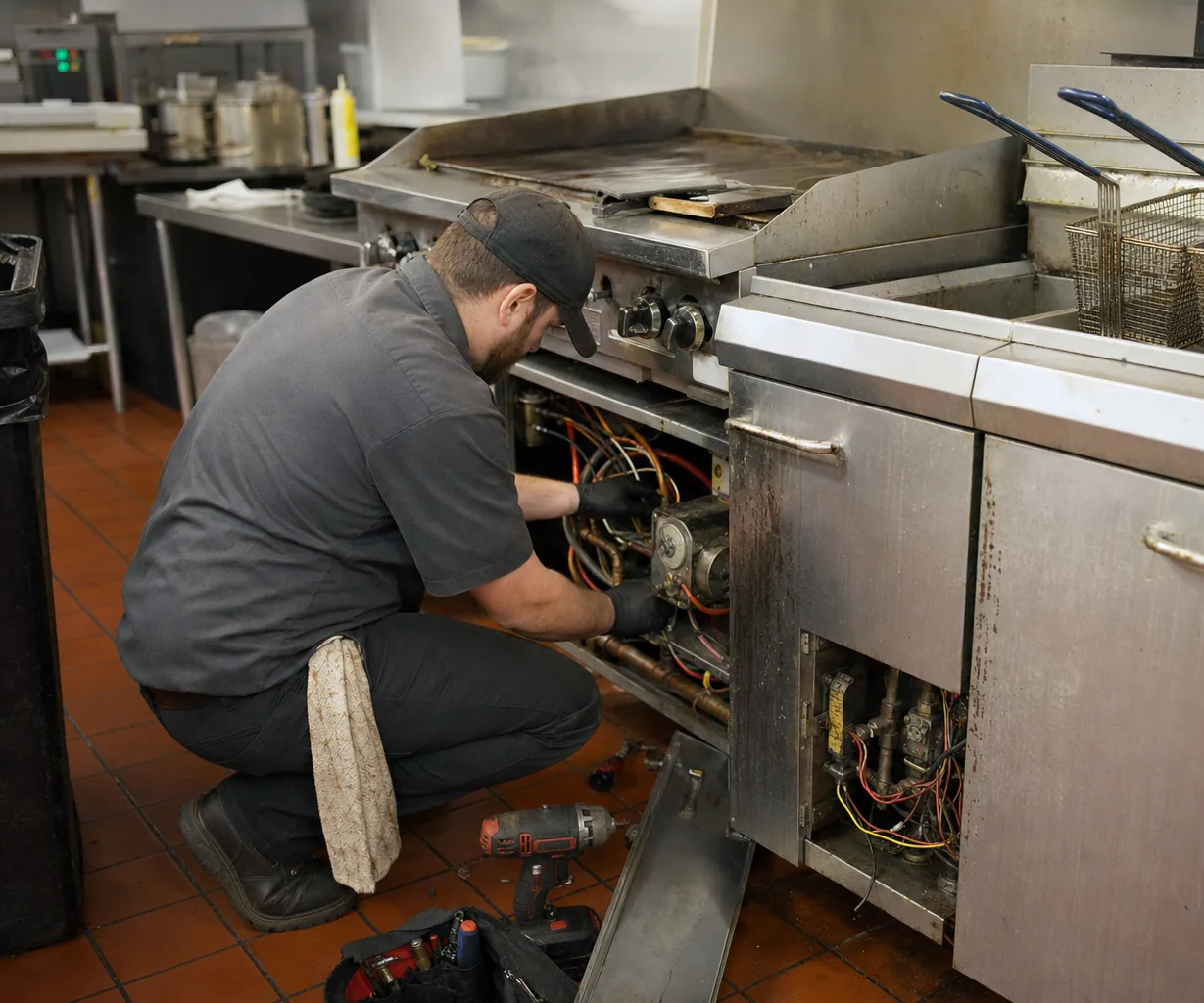
A commercial oven that won’t heat almost always traces back to one of five faults: a failed igniter or pilot, a bad thermostat or probe, low gas pressure, a burned-out element, or a tripped high-limit safety. Most are part-level repairs, and a typical commercial oven or range repair runs $300–$1,200, with the firm quote given on site after diagnosis.
The bigger cost is downtime. In downtown Port Chester, where restaurants near the Capitol Theatre on Westchester Avenue can see a pre-show rush, an oven that goes cold at 5 p.m. costs more in lost covers than the part that failed.
What makes a commercial oven run cold or slow?
Ignition. Older gas ranges use a standing pilot and a thermocouple that holds the gas valve open; newer ovens use a hot-surface or spark igniter. A worn hot-surface igniter can glow without drawing enough current to open the gas valve, so the oven glows and stays cold.
Thermostat or probe. Mechanical thermostats on many Vulcan and Garland ranges drift out of calibration. On convection ovens, a failing probe tells the control the cavity is already hot, so it stops calling for heat.
Gas pressure. A partly closed shutoff, a bad regulator or a quick-disconnect hose that isn’t fully seated starves the burners: small, yellow, lazy flames and slow recovery.
Electric heat and fans. Elements burn open, contactors stick, and a lost leg of three-phase power leaves an oven at partial heat. If a convection blower fails, the high-limit can trip and shut the oven down.
Which symptoms point to which fault?
| Symptom | Likely cause | Safe staff check |
|---|---|---|
| No click, no glow, no flame | No power to controls, ignition module | Plug and breaker |
| Igniter glows, burners never light | Weak igniter or gas valve | Note it; stop cycling it |
| Pilot won’t stay lit | Thermocouple or pilot safety | Stop relighting; call |
| Small, yellow, lazy flames | Low gas pressure, clogged ports | Gas valve open, hose seated |
| 25°F or more below the dial | Thermostat calibration or probe | Thermometer test |
| Heats, then shuts off | Tripped high-limit, fan failure | Listen for the fan; door latched |
| Electric oven slow, one side cold | Element, contactor, power leg | Check breakers |
What can kitchen staff safely check before calling?
These 5 checks need no tools and no panels removed.
- Power. Gas convection ovens still need electricity for the fan and ignition, so confirm the plug and breaker.
- Gas. The shutoff handle should run parallel to the pipe, and the quick-disconnect should click fully home; moving a range for cleaning often unseats it.
- Door. Make sure it latches so the door switch is made.
- Thermometer test. Set 350°F, put an oven thermometer in the center, wait 20 to 30 minutes and compare. More than about 25°F off points to calibration or the probe. Write down any error code too.
- Stop there. Never bypass a high-limit, thermocouple or door switch. If you smell gas, don’t flip switches; get everyone out and call the gas utility or 911 from outside.
What does a cold oven cost a restaurant while it waits?
An oven running 50°F cold stretches cook times, and product can look done before it reaches a safe internal temperature, such as 165°F for poultry. Hot-held food must stay at 135°F or above, so a weak oven is a poor holding cabinet. Add 86’d menu items and overtime spent juggling one working oven.
Small faults rarely fix themselves; a weak igniter or drifting thermostat tends to quit during the busiest hour. Typical ranges are $95–$165 for the diagnostic visit and $300–$1,200 for the repair. The firm quote is given on site after diagnosis, and the service-call fee is credited toward the repair. See repair pricing for other equipment.
Commercial ranges and convection ovens commonly last 10 to 15 years with maintenance, so igniters, probes and elements are usually worth fixing. Replacement makes more sense when the cavity is rusted through or the door frame is warped.
How do you book a service call that gets the oven fixed faster?
Read the data plate (brand, model, serial), usually inside the door or behind the kick panel. Add the fuel type or the voltage and phase, plus symptoms, error codes and your thermometer reading, so the technician arrives with likely parts.
Call (914) 537-0917 for commercial oven and range repair or convection oven service. Port Chester Commercial Appliance Repair is an independent service, not manufacturer-authorized, covering Port Chester, Rye Brook, Rye, Harrison, Mamaroneck and White Plains.
Frequently asked questions
Why does my commercial oven heat but never reach the set temperature?
Usually a thermostat out of calibration, a failing probe or low gas pressure. A 20 to 30 minute thermometer test at 350°F shows how far off it is.
Is it safe to keep cooking in an oven that runs cold?
Only if you probe every batch for a safe internal temperature, such as 165°F for poultry. Schedule the repair rather than working around it.
Why won’t my gas convection oven heat during a power outage?
Most gas convection ovens need electricity for electronic ignition and the blower fan. No power means no ignition, even with the gas on.